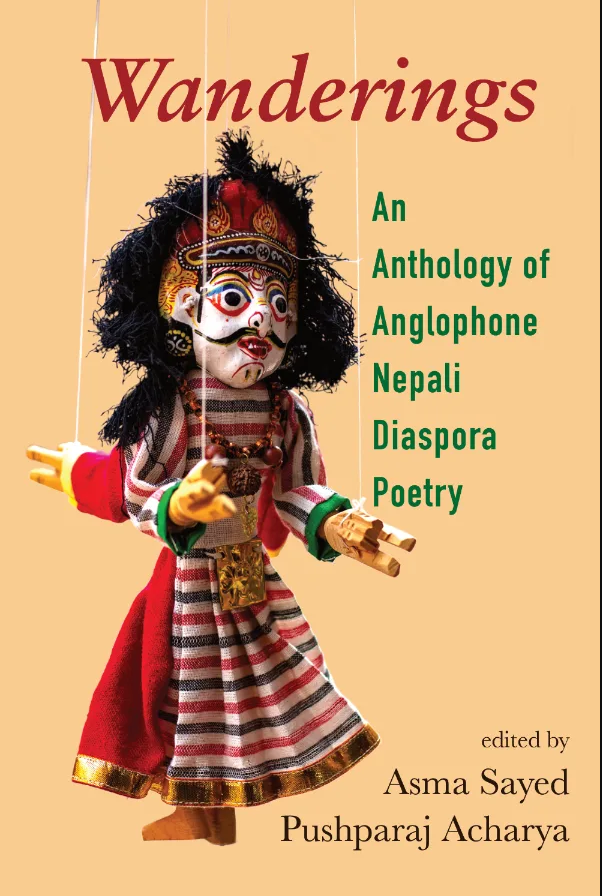
Wanderings
Featured Poet
978-1-77415-204-1
Published by Mawenzi House Publication, 2025
This collection brings together poets who trace their roots to Nepal while living, writing, and dreaming in the diaspora. It evokes cultural memory and reimagined belonging in the in-between conditions of diasporic lives. Melding global literary currents with Nepali cultural threads, the poems herein explore themes of home, nostalgia, exile, and identity in a range of forms–free verse, sonnets, ghazals, lyrical meditations, and ekphrasis. They provide a testament to the power of poetry to transcend borders.
Excerpt from the Introduction of Wanderings:
….declaring that “[e]very pine I hug is a mother,” Saraswoti Lamichhane offers a distinct view of home as she declares that she belongs to nature (“Given to the Wilderness”). Her journey reveals that one can build a home or community anywhere on Earth, embracing nature as a foundation for belonging. Beyond the themes of house and home and nature, her poems also elaborate upon the concept of a dwelling—something one creates. The poet connects with nature, recognizing it as the same Mother Earth she left behind, thus celebrating her ability to relate to and establish roots in her new land. She reclaims and relates to nature and the Earth as she finds a new home in Canada. In “Karaikhola Flows,” she is “a drunken river and demolished doors” and the force of nature: “I am the danger of a deity claiming her dwellingdom.” She finds nature and home in the rocks, forests, and rivers of Alberta and introduces them to her daughters: “I intro- duce the forest to my daughters / as if leading them to my childhood home / seven thousand miles and thirty years away” (“Homecoming”). In this claim, she transfers this new sense of home to her daughters: “From their gaze; that familiar joy; I know / they have found their own childhood home” (“Homecoming”). At the same time, Lamichhane emphasizes the strength of a woman in creating a home after migration. First, she narrates the story of her grandmother, who migrated internally and founded a new home: “a widow with her two toddlers, left Kaski in search of a better home” and then founded a farm, house, family, community, and her new life and rituals in a new place in Surkhet in Nepal (“I name her Fewa”). As the generation changes, she observes the parallels between her grandmother’s migration and her immigration to Canada and creation of a home in that new place: “I am also the seeds of the basil she carried from Kaski to Canada” (“I Name her Fewa”). Lamichhane weaves together the parallel narratives of her life and her grandmother’s, transplanting these intergenerational stories into the new soil in Canada. This understanding of home is powerful, new, and defines her relationship with the new land…
Editors:
Dr. Ashma Sayed
Dr. Pushparaj Acharya