ADVANCE PRAISE
Saraswoti Lamichane’s book is a rich and coherent tapestry of everything that must be allowed to separate yet still be held together—the interplay of generations and genders, love and distance, freedom and constraint, the foreign and home. For me, the spirit of this collection is captured beautifully in the images of one particular poem where Lamichane looks over the wide valley of the Athabasca River in the Rocky mountains. The river’s channels braid and part again, as do the memory of the poet’s childhood overlooked by Himalayan ridges. The book as a whole demands that both layers of experience must be held together. “I have either both or none.”
Alice Major, My 12th poetry collection is Knife on Snow, from Turnstone Press
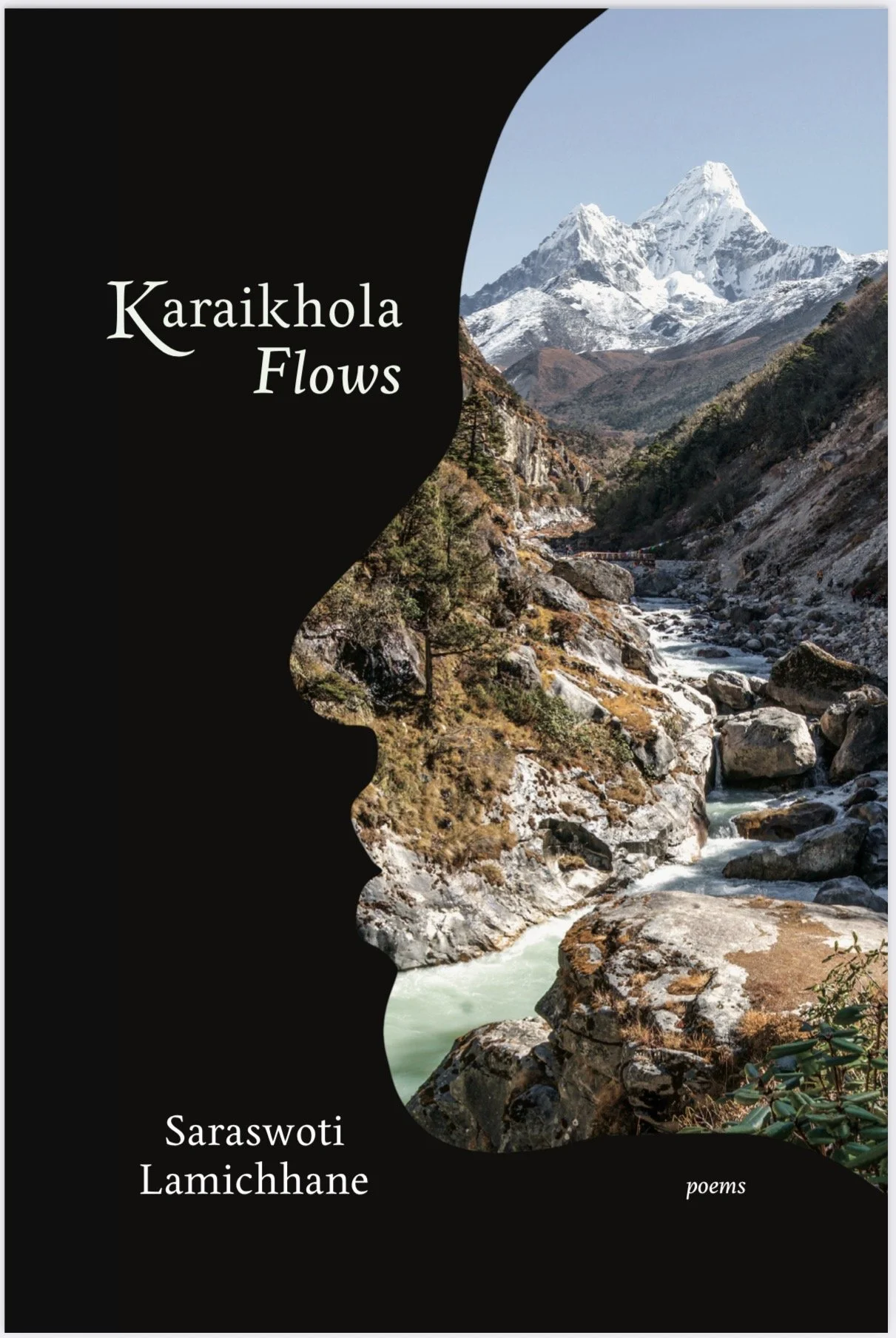
Lamichhane’s debut collection, Karaikhola Flows, is rooted to landscape, to wonder, to darker forces, to the land of goddesses, to where shadows and trees talk and to how the poet listens, talks back. From a childhood in Nepal to motherhood in Canada, here are poems where the “I” must merge the divide and still “leaving remains foreign.” Ripe with sensory details, the poems hum with Nepalese myth and landscape. They glisten and sting with an ache that seeks, and in seeking finds that “I am a daughter of the Himalayas.” Lamichhane skillfully reveals she is a “disciple of little things” with “the force of a tiger.” A lush, tender, hard-hitting debut.
Catherine Graham, Put Flowers Around Us and Pretend We’re Dead: New and Selected Poems
SaraSwoti Lamichhane’s brilliant volume of poems, Karaikhola Flows, traces her time as a young girl born in Nepal and her later move to Canada. As a child she was a lover of nature who delighted to climb and talk to trees. She was also fascinated with the eastern goddesses as “primal mothers.” On leaving Kathmandu she focussed on lyrical poems which combine her experiences in both settings. The volume traces her times in Toronto, Alberta, and the Pacific Coast where she introduces the forests and wild animals to her daughters. Near the end of the volume the poem “Mudra, (meaning a focal point for meditation) states: “Purity pours, / the bindu (a focal point for meditation) of my soul chants / Peace, freedom / my reflections on still water / Here, now.”
Susan McCaslin, a poet whose most recent volume of poetry is Named & Nameless (Inanna Publications, 2025)